How social media has a negative impact on our inner beauty
- Emma Taylor

- May 25, 2020
- 8 min read
Updated: May 16, 2021
It's no secret that cosmetics can play a huge part in boosting confidence, but does the beauty scene, along with social media, generally do more damage to our mental health than good?
A young woman has reached out to me on this topic, and has a considerable amount to say regarding her harsh relationship with her appearance.
"Give me 30-mins and I'll write you a whopper!"
I'm intrigued to see why she has so much to say, so I click on her Twitter profile picture and I'm surprised at how such a lovely-looking girl could pick apart her looks so much. I see absolutely nothing wrong with her - instead, I think 'I wish my skin was as clear as hers', and 'how nice is her hair!?'
Unfortunately, in today's society, more and more people are quick to put themselves down, and this negative impact has become concerning to their mental well-being.
"I was just 11-years-old when I first started criticising my appearance. My acne was awful and is what initiated my issues with self-confidence in the first place. It then developed into things that aren’t necessarily seen as obvious things that should be criticised, like thinking my mouth is too wide, my face is too round and I have no jawline.
"As I started to spend more time on Instagram, I then began to look at the things that are more commonly criticised such as ‘my nose is too big’, ‘I wish my hips were bigger’, ‘I wish my boobs were bigger’."
Now, at 19-years-old, Danielle Burnard is just one of the many young women who has struggled with her image, and put herself down since using the popular social media platform.
"At one point, Instagram made me feel so awful about myself that I would cry looking in the mirror."
For people like Danielle, makeup has been a godsend in hiding those annoying blemishes that can lead to such self-criticism issues. If there's an area of your face that you're not particularly fond of, there's almost always an answer with makeup. Got tired eyes? Colour corrector. Want to cover those spot scars from your teenage years? Concealer. Feel like your complexion needs a pick-me-up? Foundation.
Imperfections are quite easily manageable with the help of cosmetics products, but these transformations are only temporary, and this can be quite detrimental to our self-esteem.
Granted, when skin is looking dull and flat as a result of contributing factors like tiredness or dehydration, makeup can be the ideal makeshift fix. Some people even think they achieve better and accomplish more when they feel they look their best, and become a more confident version of themselves, as they're not worried about their image. However, when makeup has been applied once and that mask of 'perfection' has been seen by others, it's often found quite difficult to be seen without it, as we worry about how others will see us in comparison.
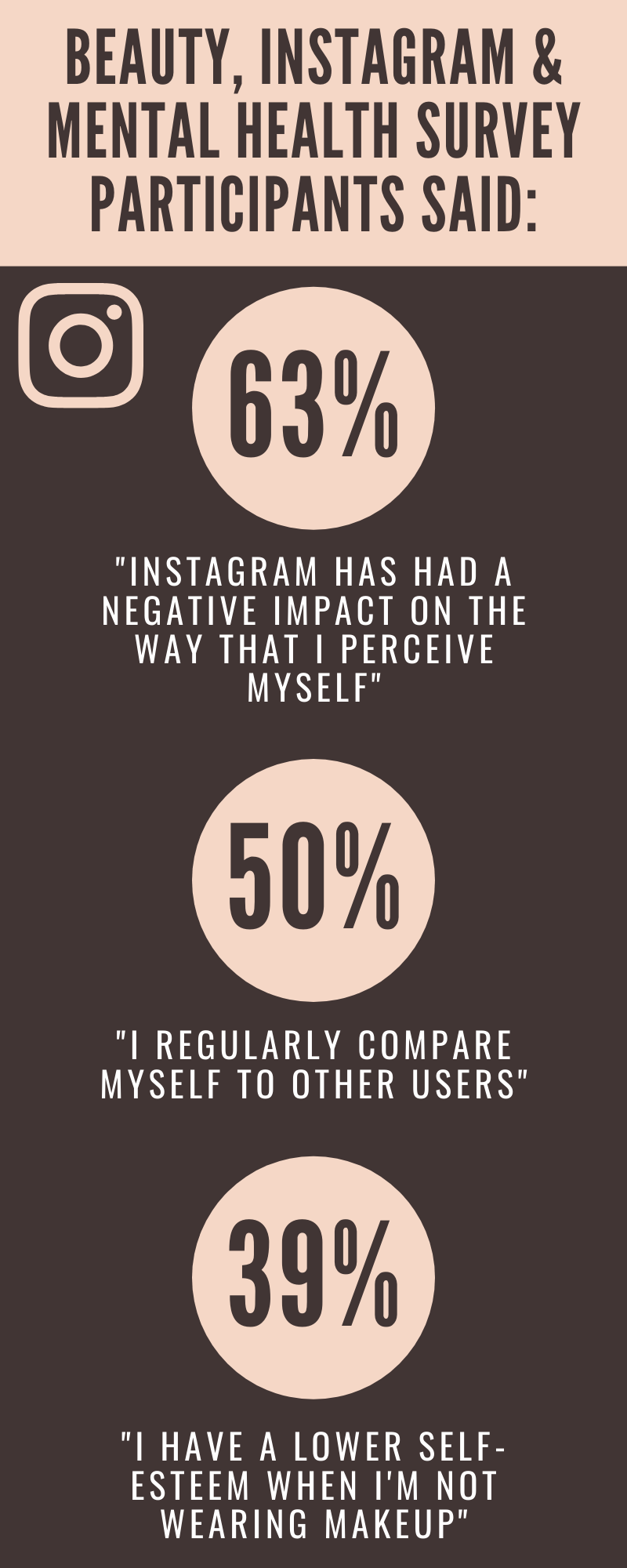
In a recent survey, 39% of participants agreed with the statement 'I have a lower self-esteem when I'm not wearing makeup, while 17% said they strongly agree.
Makeup can actually have an overall negative impact on the way that we perceive ourselves when our faces are bare, and make us feel worse in our own skin. When masked with cosmetics products, flaws will certainly not vanish, they will simply be temporarily masked and maybe even made worse than they already are. While scars will inevitably stay on your face forever, imperfections such as spots and blackheads will be worsened as a result of applying makeup, and can cause even more damage to natural skin. Ultimately, when makeup is taken off it can make someone feel worse about themselves, because it becomes easier to love the mask of 'perfection' created with cosmetics products instead of natural beauty - It can be quite the addictive circle.
As a GP with a specialist interest in dermatology, Grant Stevens explains how makeup can be beneficial to someone with blemished skin, but how it can also have negative impacts.
"As long as [makeup] is used willingly without feeling societal pressure to do so, its uses for camouflage to blend in and to increase confidence can have a positive impact on patients with marks, scars or skin conditions.
"The negative discussions I have around makeup are usually seen when an adverse reaction has occurred."
He explains that the irritants from cosmetic products can cause allergies leading to skin conditions such as contact dermatitis, eczema and hives on the face.
"The patient will quite often need patch testing to identify the cause, cease cosmetics until the cause is identified, and require some sort of topical steroid and moisturiser."
During lockdown due to COVID-19, many people have been reluctant to follow their usual makeup routine, preferring instead to be au naturale. However, when it comes to showing your face on social media, the desire to reach for the makeup brushes undeniably returns.

Instagram has often been ranked as the worst social media platform for young people's mental health, and multiple research studies have linked it to depression, anxiety and self-esteem issues. Being a visual social site, users are encouraged to share photos and videos to their followers; posting memories, pictures of holidays, work life, and photos of themselves - very often selfies.
Not only do people compare their lifestyles to other users', it is also very easy to compare appearances, and to wish they looked like the influencer, celebrity or friend that they follow.
The app comes equipped with a range of filters, and a tool that allows the user to edit photos before they are uploaded. Along with this, separate apps such as FaceTune exist, where users are able to airbrush their complexions, add definition to their faces and even reshape their bodies before posting the pictures to Instagram. Such apps most definitely set the bar high for beauty and lifestyle standards, while also setting near-impossible expectations.
Danielle continues to explain the feeling that she gets when looking at her Instagram feed compared to her own photos.
"When I was around sixteen, I would scrutinise my photos so much that I would end up not even posting them because I didn’t think they looked like how other girls did on Instagram. At that age, I had no idea about PhotoShop and FaceTune, and angles and airbrushing, and everything else that went on behind the picture. I just saw the image in front of me and couldn’t understand why I didn’t look like that."
Mental health practitioner, Megan Waddle, helps people to overcome depression and anxiety. She often encourages young people to be aware of the accounts that they follow, as some of them set unrealistic standards, and make them feel worse about their own image.
"Our guidance when working with young people as practitioners is to always talk about social media; that is whether they are being bullied and the nature of this but also about the types of pages that they have in their feed. I often speak to young people to be mindful about which pages and/or people they follow, and suggest to unfollow anyone that may be triggering for them."
When scrolling through the endless 'perfection' on Instagram, it's not just the makeup side of beauty that can impact our mental state - body image can be massively affected too. Some Instagram posts that are uploaded can have unrealistic body images, setting false expectations for others. It is easy to fall into a trap of disliking your own body once seeing another that you desire to have.
In a recent survey, 50% of participants said that they regularly compare themselves to other Instagram users.
Megan carries on to explain that being harsh on yourself as a result of social media can lead to further mental health issues.
"Having an obsession with the way you look, constantly comparing yourself to others or striving to change your appearance directly impacts everyone's mental health. People can become very socially anxious due to the perceived negative thoughts from others about the way they look, and this stops them being able to function day-to-day."
"There has been a shift with high street/online shopping pages [that] share body positive images which is great, and there are also body positive specific pages on Instagram that I usually suggest people to follow."
Victoria Spence (@victorianiamh) is just one of the many body-positive influencers on Instagram. She has previously suffered with her own body image and believes that the social platform once played a significant part in leading her to a dangerous battle with anorexia.
“Instagram definitely had a negative impact on me. I was following so many girls who competed in bikini competitions thinking that they were really healthy because they exercised and ate a certain way. Back then I had no idea what health implications being super lean had on the female body, so I aspired to be like that. I thought they were the image of health."
But after hitting her lowest point and being fed up with feeling so down and unwell, she decided to make a positive change and concentrate on getting to a healthy weight while being happier and stronger in the process.
“I realised that being really lean was not all that it was made up to be. I thought it would make me happy, and feel more liked, and almost like I was significant if I had a set of abs, but in reality, It made me feel isolated, low in mood and pretty depressed. So, when I finished my last [bikini] competition, I knew that in order for me to find real happiness I needed to let go of body image hang ups and focus on the things that mattered and developed me as person."
“I was getting so many more opportunities in my healthy body, which made me realise that I was so much more than my body. I had a lot more to bring to the table.”
Although Victoria believes that Instagram had the initial negative affect on her body image, after hitting her lowest point she has made it her mission to change other people's outlook of themselves. By using her platform, she now promotes to her 100k followers that they should love their bodies for the right reasons, and that it's completely normal to have insecurities. Her sole purpose on Instagram now is to not only document her own progress with her body and mindset, but to be a role model to others.
“Near enough the whole world is on Instagram, so I feel my role on the platform is to be somebody who brings an element of realness and honesty as opposed to creating an image of this perfect body and perfect life through editing.”
It’s refreshing to see that a large amount of positive Instagram accounts have been created to break up the 'perfection' that we often see on our feeds. This brings a sense of ‘realness’ into what can be a very false social platform.
“Before I post things which are deemed as ‘shameful’ or ‘embarrassing’ for women I sometimes feel a little nervous, but then I remember that it isn’t about me, it’s about the people who follow me.
"I would rather myself feel uncomfortable for airing an ‘insecurity’ than thousands of women feeling shameful because they think that they are the only people who have things like tummy rolls and body hair. I also know myself enough to know that I am much more than my appearance, so if people were to judge or be negative about my body, I know that it's their issue, not mine.”
Thankfully, there are many accounts on Instagram, like Victoria's, that aim to steer young people's minds away from the idea that they need to be 'perfect' all the time.
Danielle is particularly grateful for this positive shift on Instagram, as these accounts have helped her to love herself again.
"I've put on weight while in lockdown which did make me feel a little insecure, but body positive accounts have made me feel confident enough to go to the beach today actually!
"One account, who isn’t really a very big account, but has made me start to love the body I was born with is Elle Delia - she posted a completely natural photo and YouTube video of her doing fake tan with her bikini on and was so confident even though she wasn’t necessarily the skinniest! She tells people to stop being so hard on themselves and I really needed to hear that!"


Comments